FundFlow: Building Financial Discipline For Students
project image

Role

Sole Product Designer

Timeline

Sept. 2024 - Dec. 2024

Industry

Fintech

Managing finances as a student can be challenging, with limited income, academic expenses, and the temptation of impulse spending. Many students struggle to build healthy savings habits, plan for long-term goals, and manage debt effectively. This project focuses on developing a student-focused savings application that simplifies financial planning, promotes disciplined saving and provides tools to help students achieve financial security during and after their studies.The app is designed to empower students to save, budget, and manage debt, enabling them to build habits that lead to financial independence. It introduces innovative features such as goal-based savings, group savings, and a unique lock funds feature, allowing students to secure savings until after graduation, ensuring they have funds available for important life transitions.

Business Goal: Promoting Financial Responsibility Among Students

The business goal was to help students save with discipline by introducing a structured, user-friendly app tailored to their lifestyle. FundFlow empowers students to set target savings goals (e.g., graduation, travel, emergency funds), lock funds to prevent impulse spending, collaborate through group savings for shared goals and track income, expenses, and debts in one place. The product’s vision was not just to help students save, it aimed to build lifelong financial responsibility.

Market Size & Growth

The student fintech market in Africa is expanding rapidly, driven by rising smartphone adoption and the demand for accessible financial tools. Over 25 million tertiary students across Africa manage money digitally, yet only 15% use structured savings tools. In Nigeria alone, youth fintech adoption grew by 45% in 2024, indicating strong potential for student-focused solutions. This gap represents an opportunity to position FundFlow as the leading savings companion for students.

Forecast & Strategy

The forecast centred on achieving steady adoption by partnering early with universities and student bodies to build trust and drive initial engagement. This strategy also relied heavily on using peer influence through features like Group Savings to boost ongoing engagement, alongside a referral reward system designed to encourage organic growth. The ultimate plan was for the app to grow with its users by gradually expanding into the young professional market as students transitioned after graduation, supporting them through their journey to financial independence.

Project Goal

As the designer, my goal was to create a platform that translates complex financial habits into simple, guided experiences, making every interaction feel friendly, goal-driven, and rewarding by focusing on simplicity in saving and goal-setting, transparency in tracking progress, and motivation through visual milestones and community support.

Research

Fundflow was researched based on industry trends and validated through user interviews to fit the current job market where every penny matters.For this project, I utilized both qualitative and quantitative research methods. The quantitative approach involved distributing survey questionnaires to 28 undergraduate students, while the qualitative approach included conducting virtual interviews with 2 undergraduates via Google Meet. These methods were carefully selected to ensure a comprehensive understanding of the problem and to gather valuable insights.

Some Key Findings

Financial Challenges

97% of students face difficulties managing limited income, covering school fees, and handling daily expenses.

01

Saving Habits

70% of students struggle with consistent saving due to impulse spending, peer pressure, and lack of budgeting strategies.

02

Long-Term Planning

Most students recognize the importance of saving for the future but lack tools to enforce discipline and structure.

03

Debt Management

75% of students often rely on loans or borrow money to meet urgent needs, leading to stress about repayments.

04

Desired Features

60% said a feature where they can save in groups would be appreciated, as it would help them save more consistently

05

Competitive Analysis

  • Piggyvest: Focuses heavily on general savings plans but lacks education-focused features like graduation locks or student-specific budget categories.
  • Risevest: Targets investment-oriented users but overlooks basic savings structures and day-to-day budgeting tools.
  • Cowrywise: Emphasizes structured savings, yet it lacks social and group-saving features that attract younger, collaborative users.

My Opportunity

  • Lock Funds Feature: Allows students to secure savings until graduation, solving impulse spending issues—a feature competitors lack.
  • Group Savings: Promotes accountability and teamwork, ideal for younger, socially connected users.
  • Debt Management: Tools to track and reduce debt, helping students prepare for life after graduation.

User Stories

After analyzing research insights and identifying key pain points, I converted user needs into actionable user stories. These stories helped guide the design process by focusing on what students truly wanted to achieve with the app. Each story represents a real scenario drawn from user interviews and surveys, ensuring the final product solves genuine problems and supports everyday financial goals.

User Story

As a student, I want to lock funds until after graduation so I can avoid spending impulsively

User Story

As a student, I want to save with my friends toward a shared goal so we can stay accountable.

User Story

As a student in debt, I want to track what I owe and plan repayments.
User Flow

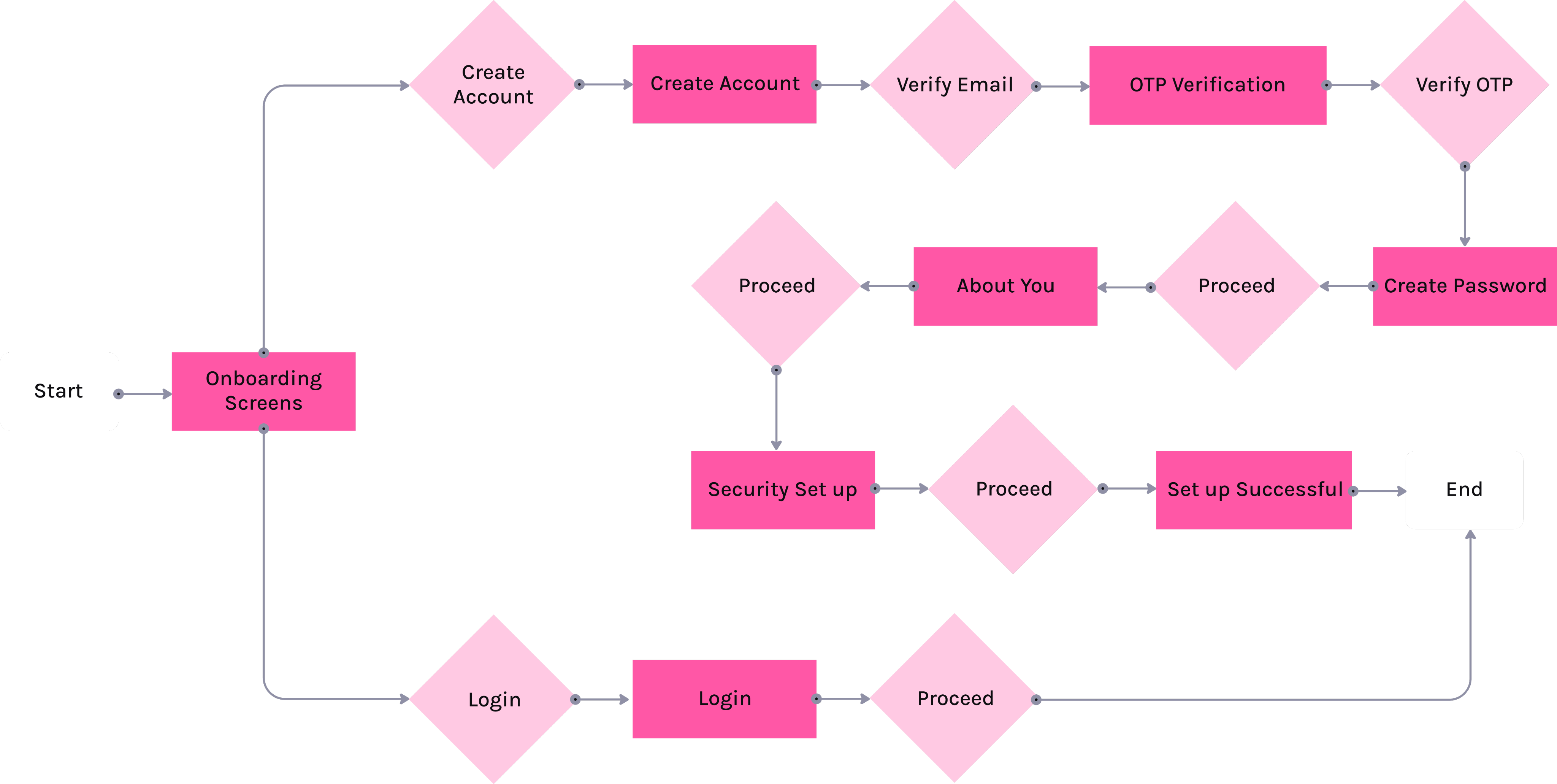
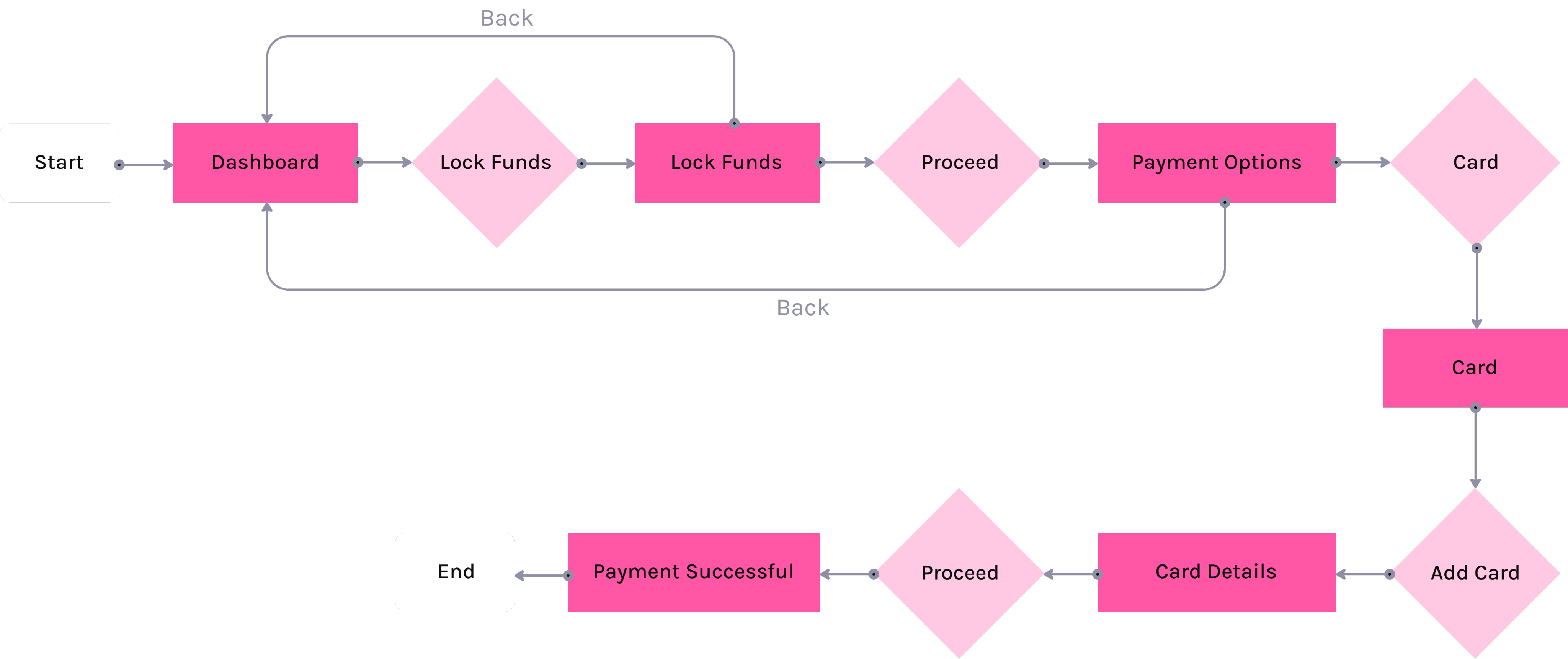
This user flow shows the roadmap that guides users through the app's functionalities, ensuring a seamless and intuitive experience. This user flow will map out the onboarding and savings flow

Onboarding Flow

This user flow shows the roadmap that guides users through the app's functionalities, ensuring a seamless and intuitive experience. This user flow will map out the onboarding and savings flow

onboarding flow
Savings Flow

savings flow
Research Reality

The core struggle students face with saving is easy access and lack of discipline, often driven by social spending and poor tracking. This research directly led to the development of the Locked Funds feature, offering a secure place for money that cannot be touched until a major milestone like graduation, directly addressing their need for long-term planning. Additionally, students reported saving better with social support, inspiring the Group Savings feature, which leverages peer accountability and teamwork to boost commitment toward shared goals.To make saving more achievable, the research revealed students struggled to budget for specific items like rent, food, or textbooks, leading to the creation of Target Savings, which allows them to track progress visually across separate financial "pots." A final significant pain point was managing informal and quick-loan debt; this inspired the Debt Management feature, providing a structured way to list debts, set repayment schedules, and track progress to become debt-free. Complementing financial security, the app also includes a Job Portal to connect students with internships and work opportunities, supporting their savings goals by helping them earn income.These features were shaped directly from student pain points, turning real challenges into simple tools that make money management easier, clearer and more achievable.

On Boarding

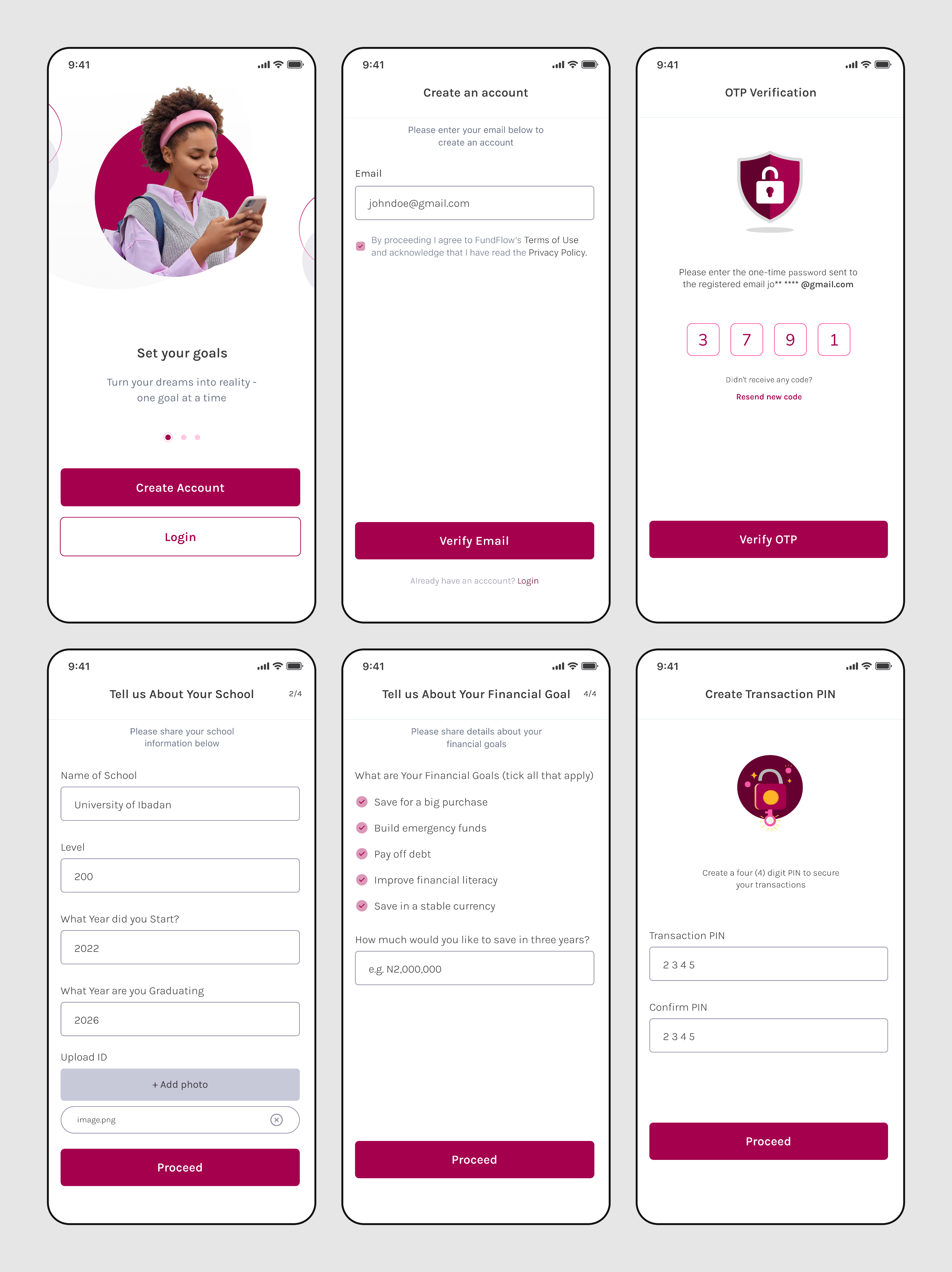
OTP Verification: Security is established through a One-Time Password (OTP) sent to the registered email address.

School Information: The app collects academic details, including the school name, current level, and start/graduating years, since it is tailored to students.

Identity Upload: Users are required to upload an image of their identification (ID) document.

Financial Goal Definition: Users define their financial goals by ticking applicable categories (e.g., save for a big purchase, improve financial literacy).

Future Savings Target: Users must specify a desired savings amount they would like to have in a set timeframe (e.g., three years).

Transaction PIN: A mandatory four-digit Transaction PIN is created to secure future transactions.
onboarding flow
Dashboard

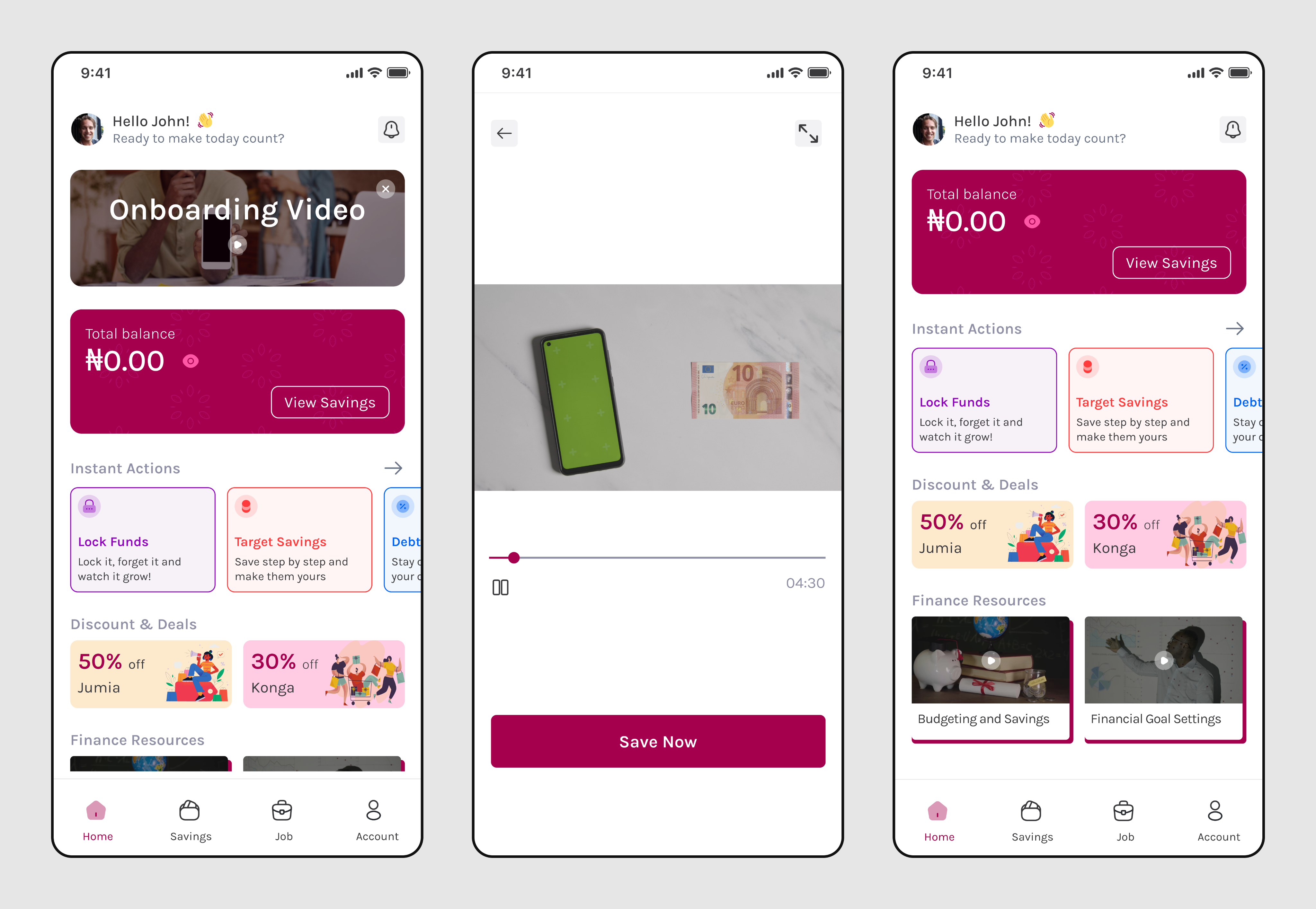
Onboarding Guide: A prominent "Onboarding Video" is displayed to guide new users.

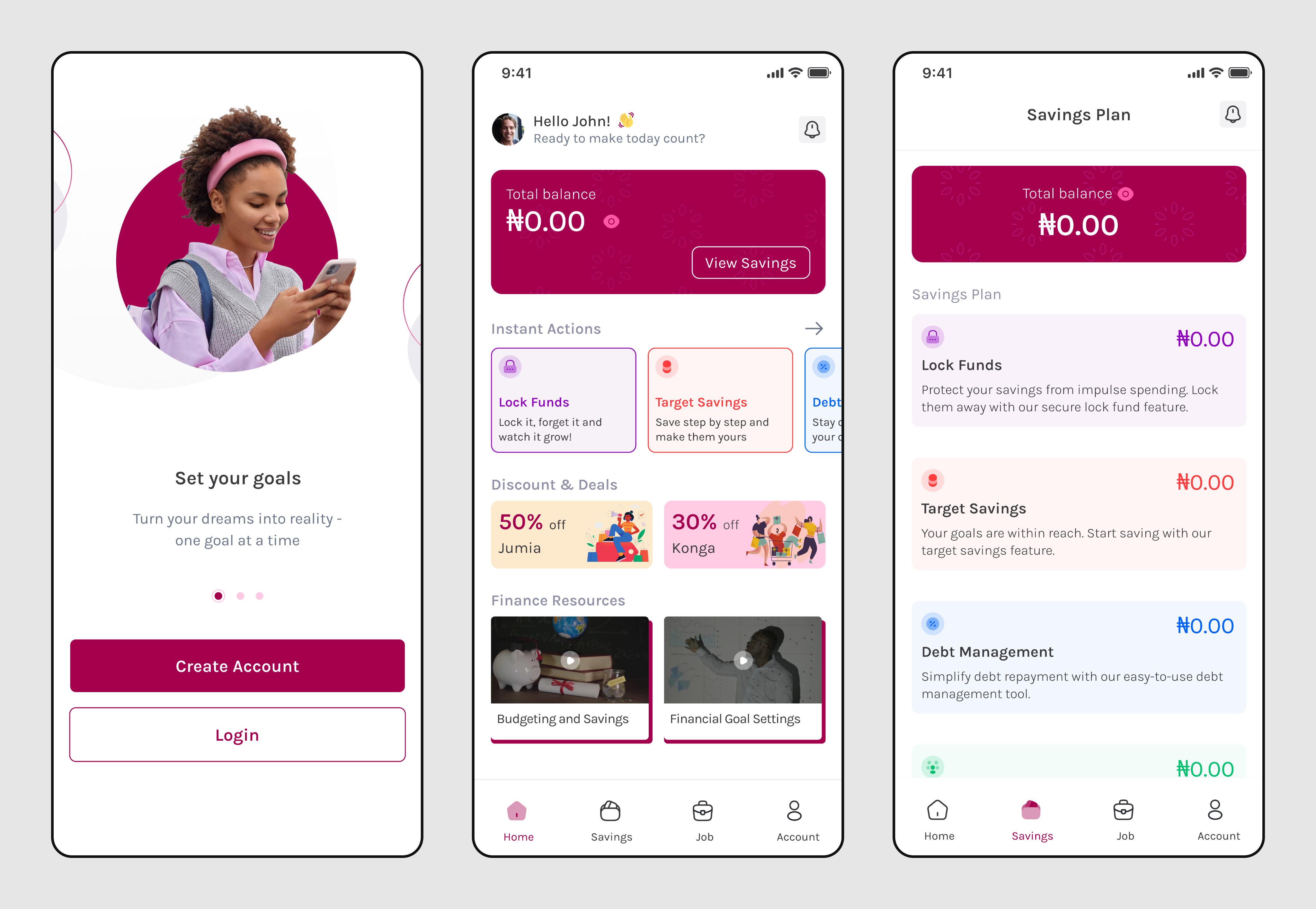
Total Balance Summary: The user's "Total balance" is visible with an immediate link to "View Savings."

Instant Access to Key Features: Quick-access cards are provided for core functions like Lock Funds, Target Savings, and Debt Management.

Incentivized Savings: A "Discount & Deals" section promote saving by offering deals from partners.

Educational Resources: A "Finance Resources" section provides links to learning materials on topics like "Budgeting and Savings" and "Financial Goal Settings."
onboarding flow
Savings Plan

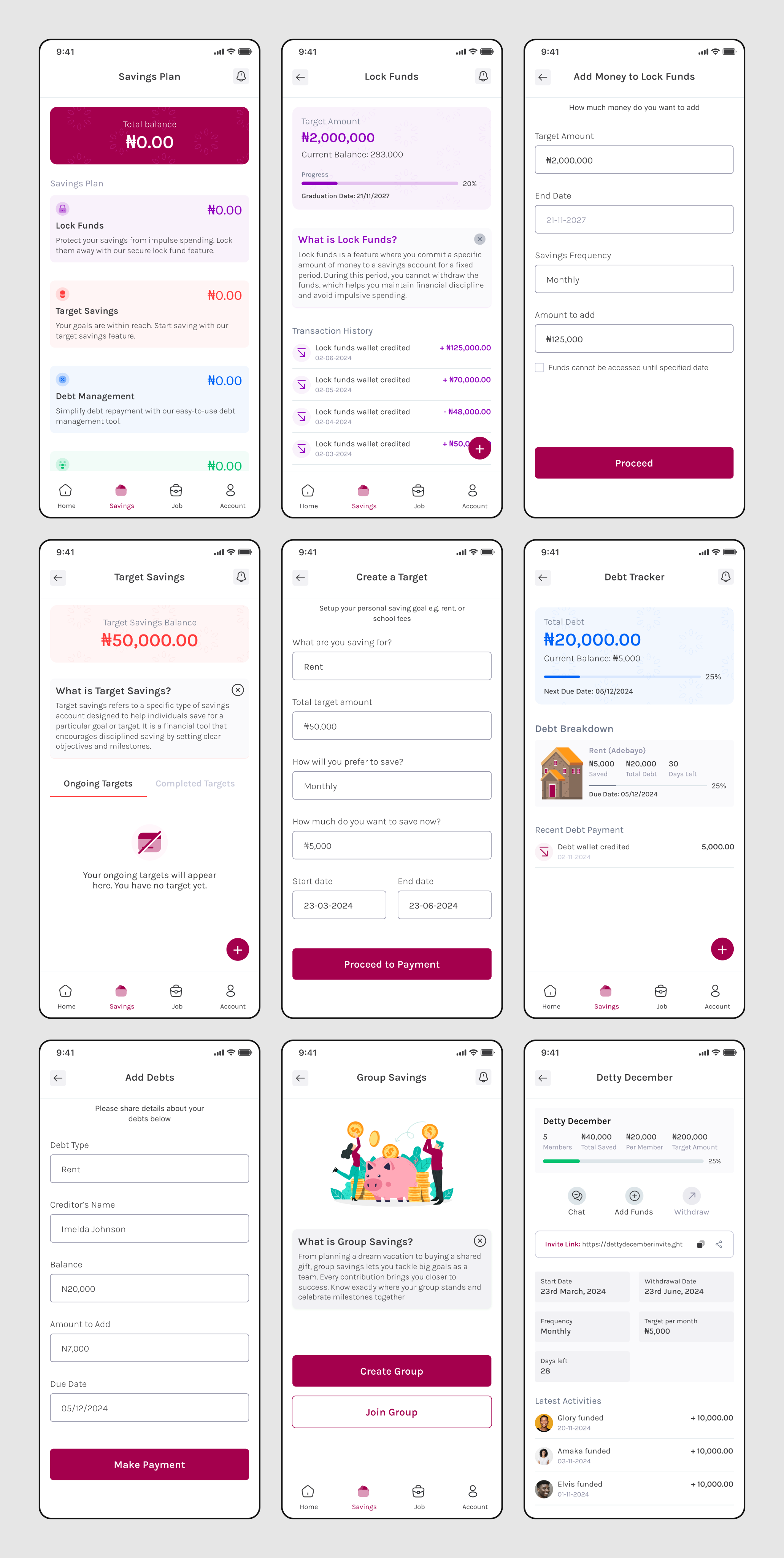
Dedicated Savings Dashboard: The main screen provides a comprehensive overview of the total savings balance and different plan categories (Lock Funds, Target Savings, Debt Management).

Lock Funds: Users can secure savings long-term toward a specific target with a visual progress bar.

Target Savings: Users can create separate savings pots with visual tracking toward specific goals (e.g., Rent).

Debt Tracker/Management: A dedicated feature helps users track their current debt balance with a visual progress indicator.

Group Savings: A feature allows users to create or join groups to save collectively, promoting social accountability.
onboarding flow
Job Board

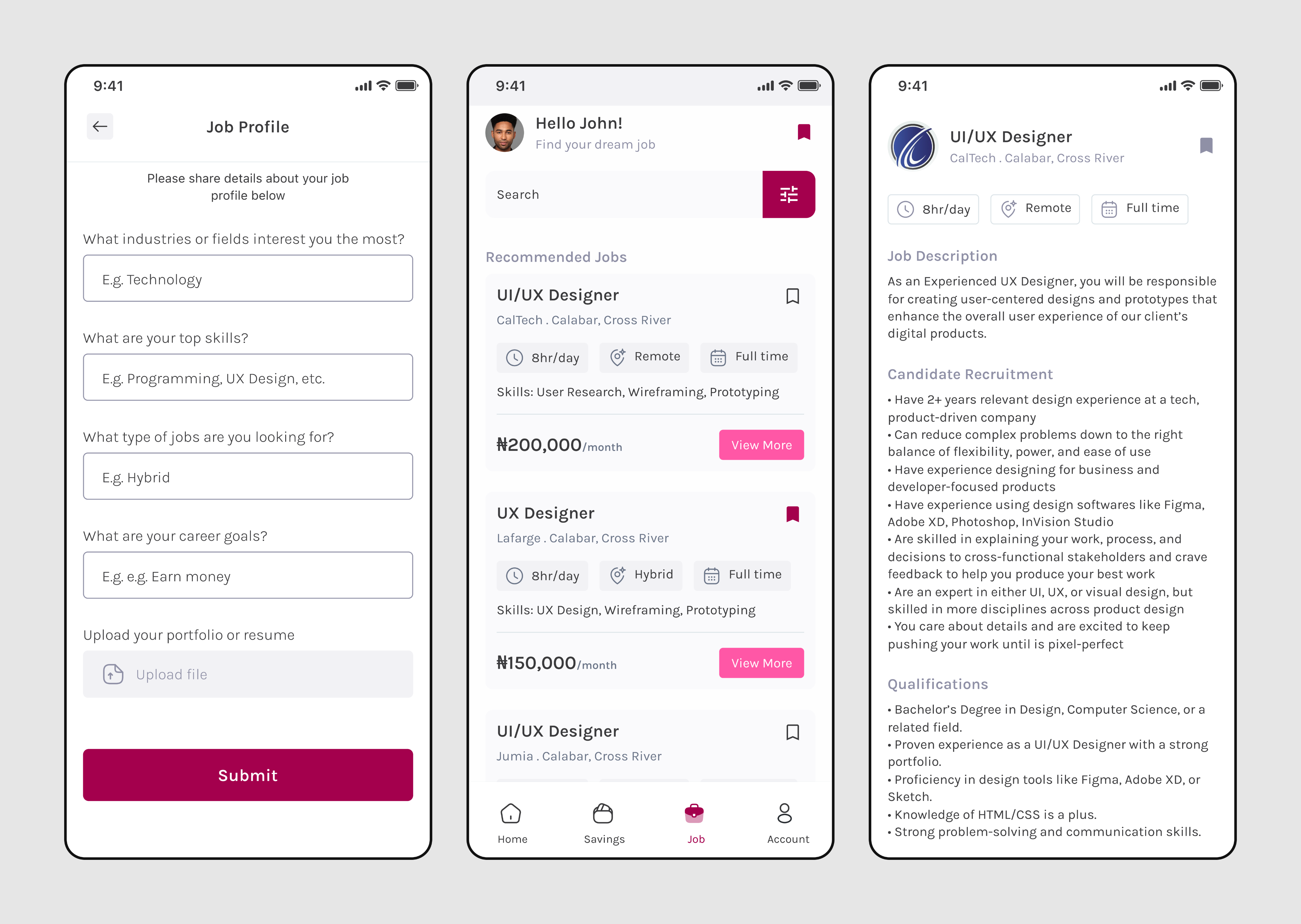
The job feature allows users to create a job profile that matches their interests, making it easier to find suitable jobs. Users can apply for jobs directly through the app and save jobs to apply for later.

onboarding flow
Other Screens

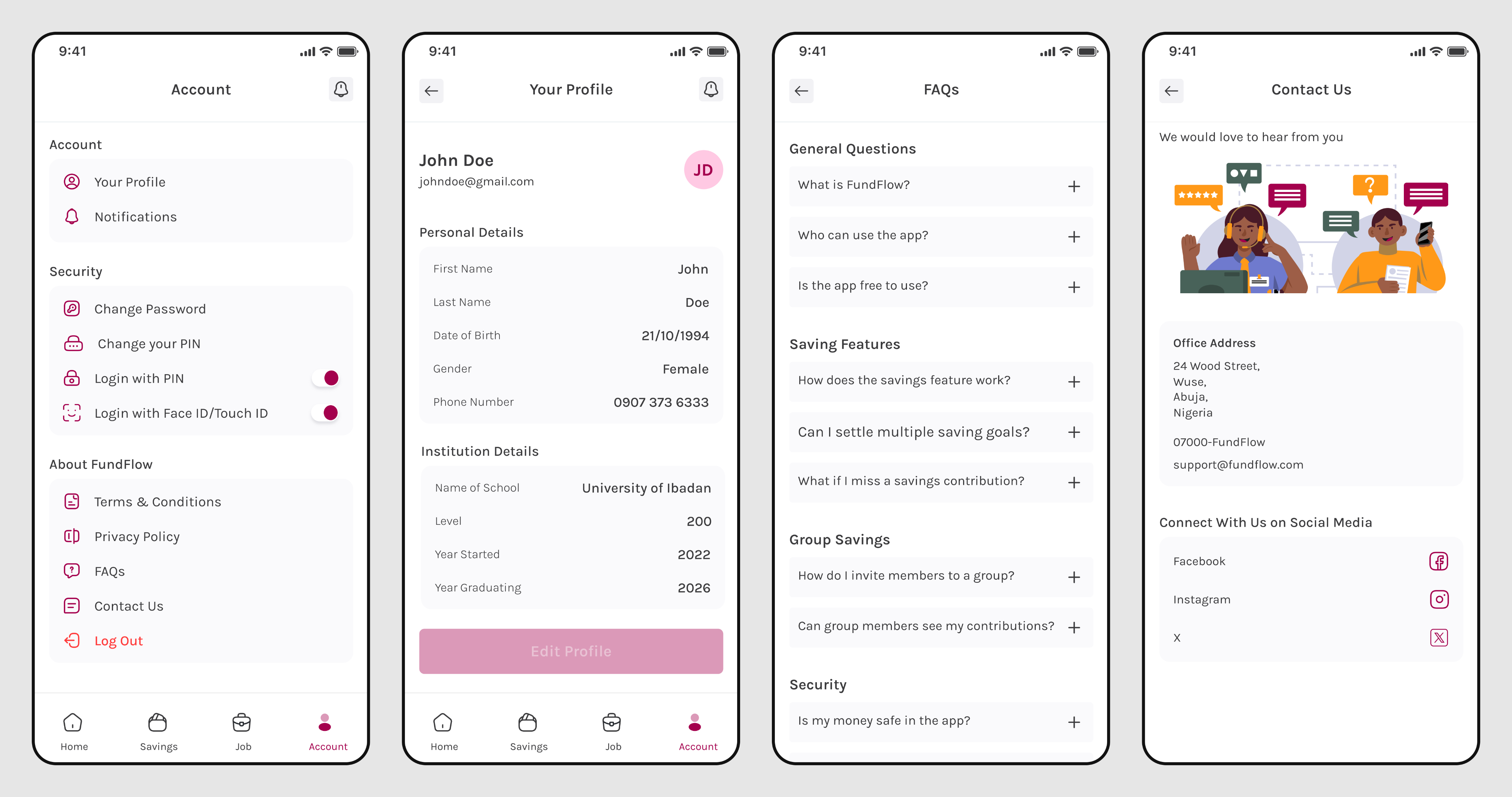
The account page lets users do various things in the app, like changing their password and PIN, agreeing to the terms and conditions, checking frequently asked questions, and finding ways to contact the company.

onboarding flow
User Testing

The user testing for this application was conducted with four participants via remote usability testing sessions lasting 45-60 minutes each, utilizing Google Meet and TLDV for data collection. The methodology focused on observing user behavior, recording difficulties, and gathering feedback through post-test interviews and surveys. Key metrics for evaluation included task completion rates, time taken, and error rates across critical functionalities like the Onboarding Experience, Lock Funds Feature, Target Savings, Group Savings, and overall Navigation and Usability.Key findings revealed that while the Onboarding Experience was largely successful, with 90% completion, the explanations for the Lock Funds feature were unclear. Similarly, users appreciated the Group Savings transparency but immediately desired a basic chat function for better collaboration and communication among group members. For Navigation and Usability, some users found the toggle icon in the account page confusing.Based on these findings, specific recommendations were made to improve the application. To clarify the Lock Funds feature, an explainer video or tooltip should be added during onboarding. For Group Savings, integrating a basic chat function is recommended to enhance teamwork. Finally, the navigation issue can be resolved by making the confusing account page toggle icon more pronounced so its clickable function is instantly recognized by users. I ensured the implement these issues from the testing.

Looking Back

Designing FundFlow taught me that financial design is about empathy. Students don’t just need tools; they need guidance, motivation, and trust. By focusing on their real challenges, I was able to create an app that’s practical, human, and impactful. FundFlow proves that a well-designed product can make saving feel simple, social, and achievable.

Let’s Discuss

edidiongkalu@gmail.com

Project Idea

Project Direction

blue star

© 2025. All rights reserved. Edidiong Kalu.